AI vs Frontend Developers: Vibe Coding a React + TailwindCSS Monoculture

Introduction: What This Article Is and Isn’t About
This is not an article about the future of AI-driven coding, and not a debate about whether it’s good or bad. This focuses on how low-to-no-code AI tools take your vague user input (or vibes) and translate it into highly specific tech stacks and architectures. This article explains how AI attempts to engineer vibe-coded apps from scratch.
Questions I’m addressing:
Why does AI default to specific tech stacks and architectures when developing front-end applications?
Why are AI-generated apps usually only front-end applications?
What I’m not addressing (on purpose):
Will AI replace frontend developers? — Personally, I believe AI will replace frontend developers in some cases, regardless of its capabilities.
The quality of code produced by AI vs a Frontend Engineer — This may not even matter, depending on how you’re using AI. Your perspective on whether AI can or should replace developers will influence how much weight you give to that concern.
Why AI Loves Opinionated Frameworks and Why Vibe Coding Encourages This Codependency
Structure makes AI look smarter by avoiding risk and building only what it can predict.
LLMs don’t think the way humans do. They require structure and rules — not vibes — to generate coherent code. The common theme across their output is the use of well-documented systems. These systems provide the context AI needs to build applications from vague prompts. Coding tools typically don’t require most users to provide a detailed Proof of Concept or business requirements for a Minimal Viable Product. They’re designed to fill in the gaps left by users and produce an output based on the context. Opinionated frameworks give them a safe space to do that.
With vague inputs, AI defaults to template-based, predictable structures. There’s nothing wrong with this, especially if your AI strategy encourages fast prototyping. However, it’s essential to understand that these solutions are essentially template reassembly using the most popular tools. Reassembly, because AI is not making original decisions, but referencing already well-documented standards and examples to produce output.
This is also why vibe-coded apps are almost always front-end applications. They’re tangible, visual solutions and something AI can quickly show back to the user. Frontend applications are faster to ship and validate than full-stack ones, and they stay within a safe zone of UI frameworks and static templates. A full-stack application, by nature, can easily deviate from the well-documented structure that AI needs to navigate quickly and efficiently to produce a clean output. This deviation from front-end-only architectures introduces ambiguity and risk.
This also raises the question: Why would an AI coding tool even attempt to go beyond the safe, established patterns for vibe coders? From a model’s and business perspective, there’s little to gain. The goal is to produce code that runs and looks nice, not to explore or even build robust software architecture. Building full-stack applications, or using less-documented frameworks, increases the risk of generating incomplete or broken solutions and lowers the perceived usefulness of the tool. If the success metric is “Did the user get code that compiles and runs?” (the bare minimum), sticking to opinionated frameworks is the most logical strategy for AI coding tools.
AI’s Top Picks: React, Next.js, and TailwindCSS
React
React is the most widely used JavaScript framework. It’s open source, has a massive documentation footprint that serves as a foundation for other UI frameworks, and has well-established usage patterns. React is everywhere, in tutorials, documentation, repos, and online courses. This broad adoption just means more training data for AI models to work with. AI tools will rarely choose another framework when starting an application unless explicitly told to.
Human engineers might pick Angular or Vue based on personal preference, but AI will always favor React or some React-based framework due to its already massive dominance in existing frontend technologies.
Next.js
This is a very opinionated React framework, so much so that your app quite literally has to be structured a certain way in order to compile. The file system dictates the routing, layouts, and component structure, leaving very little ambiguity in how things should be organized, which is perfect for AI.
# sample of Next.js file and url structure
app/
├── page.tsx          → yoursite.com/
├── about/
│   └── page.tsx      → yoursite.com/about
├── blog/
│   ├── page.tsx      → yoursite.com/blog
│   └── [slug]/
│       └── page.tsx  → yoursite.com/blog/any-article
└── dashboard/
    ├── page.tsx      → yoursite.com/dashboard
    └── settings/
        └── page.tsx  → yoursite.com/dashboard/settings
Room for creativity in this framework is mostly limited to the pages themselves, but they all operate within the system defined by Next.js. With opinionated frameworks like this, AI is able to generate code systematically with less room for error and hallucinations. Next.js inherently provides a set of rules for development.
TailwindCSS
An AI favorite for many of the same reasons as React and Next.js. It’s well-documented, super opinionated, and highly structured. Tailwind excels as a base for UI scaffolding and visual prototyping, and it’s practically designed for copy-paste workflows. TailwindCSS class names are intuitive and arguably more readable to AI than they are to developers. I would argue that TailwindCSS and AI are perfect for each other.
Exploring Community Projects from Lovable, Claude, and Replit — Different Tools, Same Stack
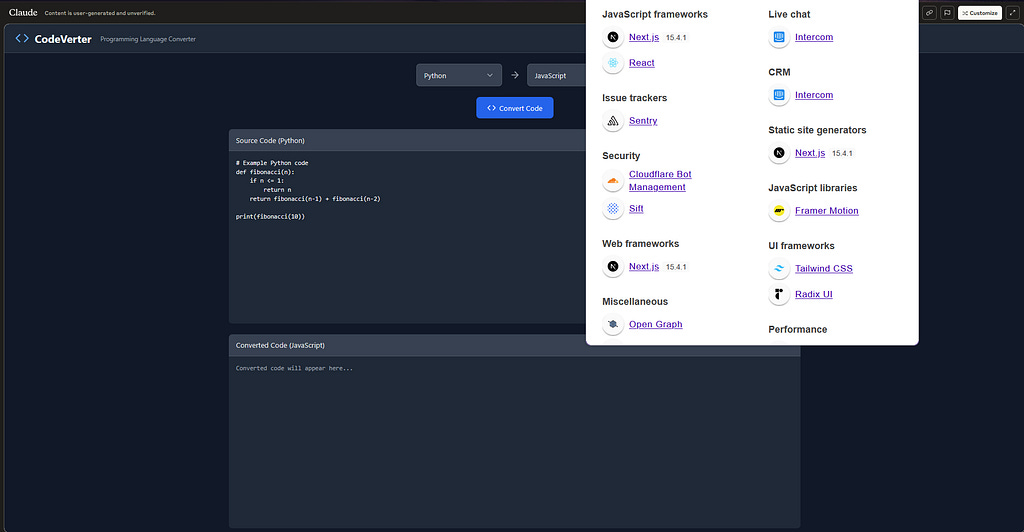
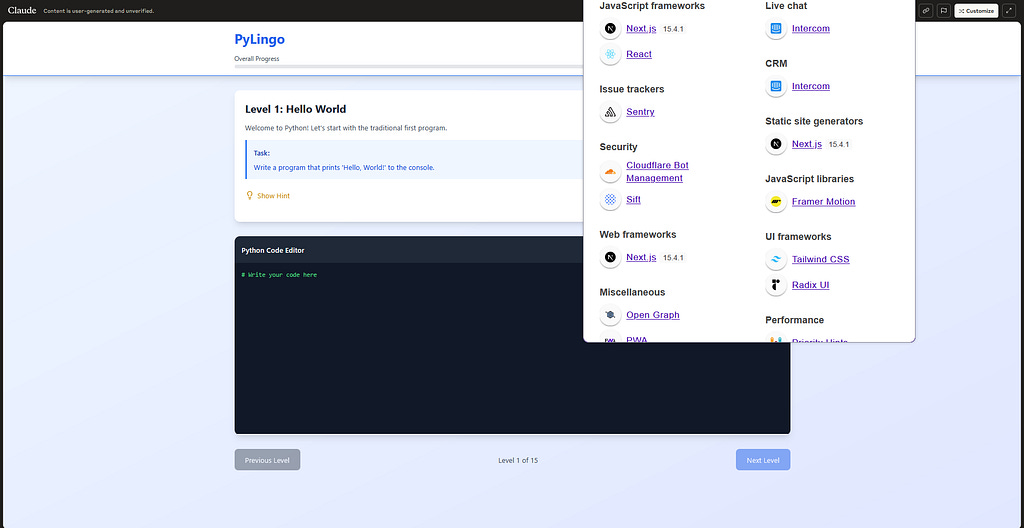
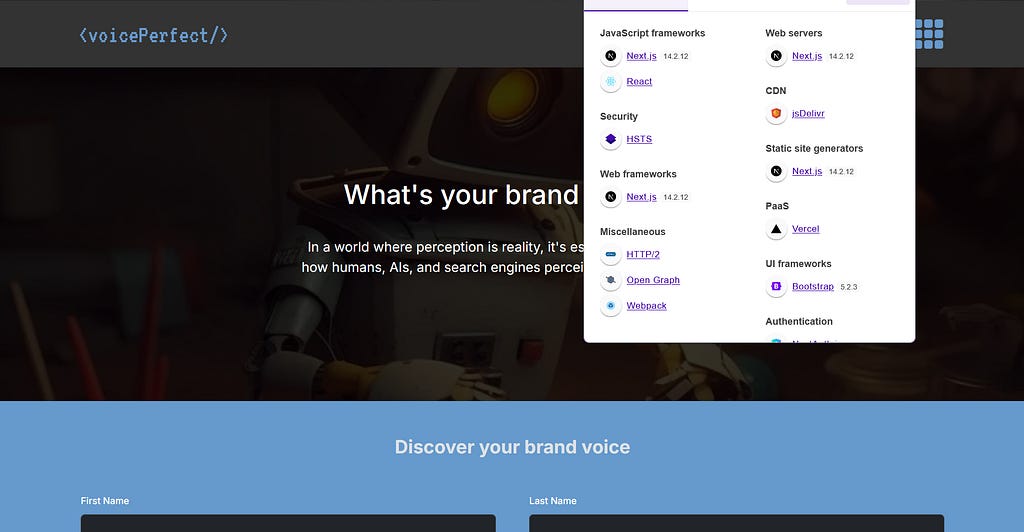
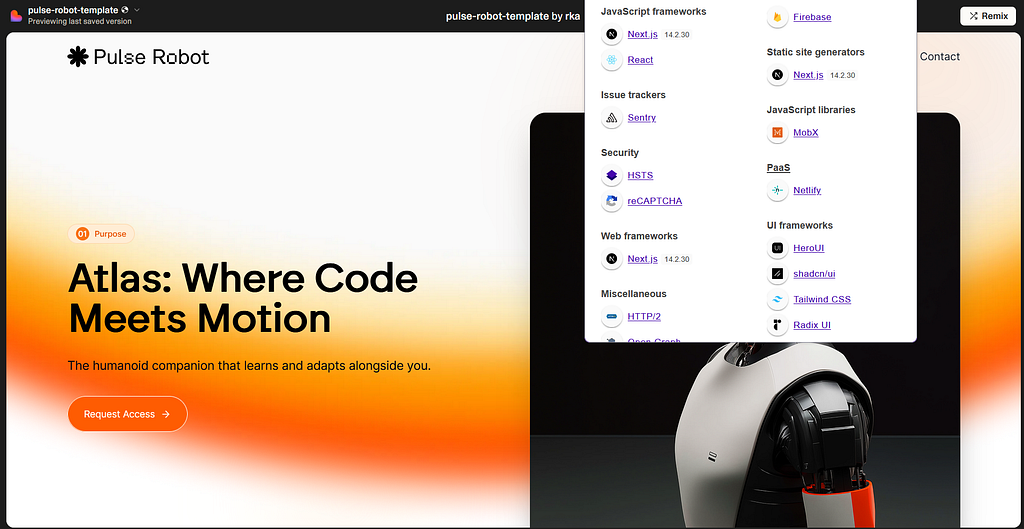
I inspected community projects from three popular generative AI tools used for vibe coding. While there were occasional deviations from TailwindCSS, they typically swapped in another well-documented, opinionated CSS framework, and in some cases, multiple CSS frameworks are used (which isn’t exactly ideal for building scalable or maintainable code). Across the board, React and Next.js were consistently used in all the highlighted projects. I used Wappalyzer for a surface-level scan, but I was also able to confirm a bundled Next.js build in each project by finding a _next directory using browser DevTools. I was also able to spot TailwindCSS's unique class names by inspecting the DOM elements.
_next directory
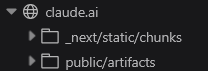
_next directory

_next directory

An Engineer’s Perspective
These apps honestly look how I expect them to look. When AI tools are fed vague prompts, they fall back on the safest, most well-documented stack they can find (more often than not, that’ll be React, Next.js, and TailwindCSS). If given vague requirements and a time crunch, I too would use Tailwind templates and opinionated frameworks for faster development and delivery.
Next.js handles page routing, SEO metadata, and asset optimization out of the box
TailwindCSS offers templates for common UX patterns to quickly build generic UIs
My take is that, in the case of rapid prototyping, use AI; in the case of software development, use AI as a tool for consulting and brainstorming with caution. These generic templates may not be the best for your use case. Start with research and planning. Use AI tools to determine the most suitable tech stack for your app’s technical needs, and then vibe code accordingly.
Where AI fails in software development (and where does vibe coding even stand?)
Coding without understanding the business case is a waste of time (and money). This is something that extends beyond engineering. AI generates content, even if the request is flawed or incomplete, and with the computational capability of AI, that waste can compound at scale.
With LLMs using chatbot interfaces, for every prompt, AI will produce an output, regardless of the prompt’s content. That’s how these models are designed, but generation without intent is just output. Literally just output.
These tools aren’t just replacing coders — they’re bypassing everything up and downstream: product discovery, problem validation, requirements gathering, edge case handling, tradeoff discussions, prioritization, testing, and business alignment. And for what? A faster output?
Whether or not the code was written by AI isn’t the real question.
What good is code if it doesn’t solve the problem it was meant to address?
Code that compiles is not the same as a product that works.
AI strategy should align with the technical and business strategy. Why would you abstract the software development of your software product to another software product?
Vibe-coded projects already significantly disrupt the SDLC from conception, so maybe they shouldn’t follow it at all. Should vibe-coded projects even have a life cycle? Why not just vibe code the next iteration, too? How sustainable is this AI-dependent process?
Conclusion and Takeaways
The real winners here are opinionated frameworks. AI reinforces market presence by consistently favoring these predictable frameworks in vibe-coded apps. Tools like Vercel and v0 create an ecosystem from development to deployment centered around Next.js. They’ve built around AI’s need for structure and created a closed loop where vibe coders, who may not be too technical, can build, manage, and deploy their apps without ever leaving their platform.
Use AI as a coding tool, but don’t think of it as an engineer. It’s great for brainstorming, scaffolding ideas, and fleshing out prototypes. These tools are revolutionary in the sense that they allow you to fail fast and move quickly early on, but they don’t replace your knowledge, creativity, and expertise. If you don’t understand the decisions behind the code, you’re not engineering, just generating patterns that look right, feel close,… but ultimately are just generic UI templates.